In this post:
If you ask any polyglot or linguistics expert for the fastest way to start speaking a new language, they will almost always give you the same advice: focus on high-frequency verbs.
In Mandarin Chinese, verbs are your ultimate superpower. Why? Because Chinese grammar has zero verb conjugations. There are no past tense suffixes (like -ed), no irregular verb charts (like go/went/gone), and no grammatical gender or person agreement (like in Spanish or French).
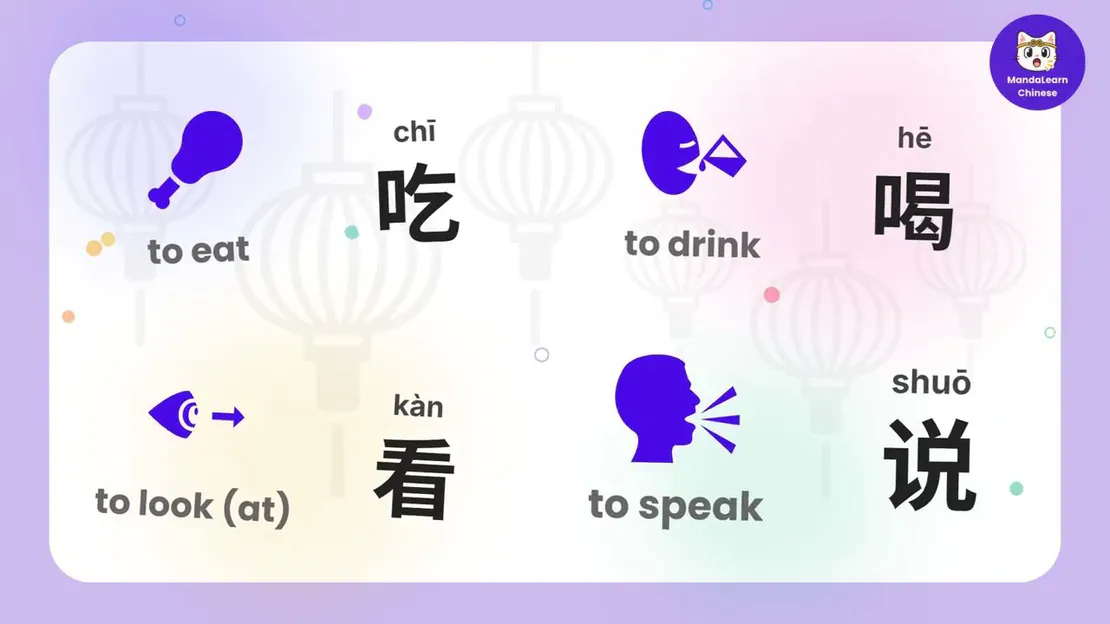
Once you learn a Chinese verb like 吃 (chī - to eat), it stays 吃 forever—whether you are eating today, ate yesterday, or will eat tomorrow. By simply combining a subject with a verb and an object (Subject + Verb + Object / SVO structure), you can instantly construct hundreds of practical, everyday sentences.
To help you build a solid foundation, Miss Manda has created a comprehensive video lesson covering the 45 most essential Chinese verbs every beginner needs.
Below, you will find the full video lesson, categorized cheat sheets with Pinyin, real-life sentence examples, and timestamp links so you can practice pronunciation on repeat.
📺 Video Lesson: 45 Essential Chinese Verbs with Miss Manda
Watch the full 13-minute lesson below. We strongly recommend using the Shadowing Technique—listen to Miss Manda’s native pronunciation and immediately repeat each word aloud to lock in your muscle memory and tone accuracy.
⚡ The 45 Verbs at a Glance (Overview)
| Category | Actions Covered | Key Verbs Included |
|---|---|---|
| 1. Daily Life & Habits | Eating, drinking, sleeping, dressing | 吃 (eat), 喝 (drink), 睡 (sleep), 穿 (wear), 脱 (remove) |
| 2. Perception & Feelings | Emotions, desires, communicating | 看 (watch), 说 (speak), 想 (want), 喜欢 (like), 爱 (love), 听 (listen), 问 (ask) |
| 3. Study, Work & Tasks | Office, studying, transactions | 写 (write), 读 (read), 学 (learn), 有 (have), 买 (buy), 做 (do) |
| 4. Movement & Posture | Travel, postures, physical motion | 去 (go), 来 (come), 坐 (sit), 站 (stand), 走 (walk), 跑 (run), 飞 (fly)… |
| 5. Physical Actions & Hands | Chores, object manipulation | 打 (play/hit), 拿 (hold), 放 (put), 开 (open), 关 (close), 洗 (wash)… |
1. Daily Life & Consumption (日常饮食起居)
These 5 fundamental verbs describe your core survival routines throughout the day—from waking up and dressing to eating and sleeping.
| Hanzi | Pinyin | English Meaning | Watch Audio |
|---|---|---|---|
| 吃 | chī | to eat | ▶️ 00:25 |
| 喝 | hē | to drink | ▶️ 00:34 |
| 睡 | shuì | to sleep | ▶️ 06:12 |
| 穿 | chuān | to wear / put on | ▶️ 08:55 |
| 脱 | tuō | to take off / remove | ▶️ 09:16 |
Real-Life Sentences:
- 吃 (chī) — to eat
- 我吃苹果。(Wǒ chī píngguǒ.) — I eat an apple.
- 喝 (hē) — to drink
- 我喝牛奶。(Wǒ hē niúnǎi.) — I drink milk.
- 睡 (shuì) — to sleep
- 我睡得好。(Wǒ shuì de hǎo.) — I sleep well.
- 穿 (chuān) — to wear
- 我们穿衣服。(Wǒmen chuān yīfu.) — We put on clothes.
- 脱 (tuō) — to take off
- 孩子们脱鞋。(Háizimen tuō xié.) — The children take off their shoes.
2. Perception, Feelings & Communication (感知与情感沟通)
These verbs are essential for expressing thoughts, asking questions, and connecting with people in conversation.
| Hanzi | Pinyin | English Meaning | Watch Audio |
|---|---|---|---|
| 看 | kàn | to look at / read / watch | ▶️ 01:01 |
| 说 | shuō | to speak / say | ▶️ 01:07 |
| 想 | xiǎng | to want / would like to / think | ▶️ 01:57 |
| 喜欢 | xǐhuan | to like | ▶️ 02:10 |
| 爱 | ài | to love | ▶️ 02:27 |
| 听 | tīng | to listen / hear | ▶️ 02:46 |
| 问 | wèn | to ask | ▶️ 05:41 |
Real-Life Sentences:
- 看 (kàn): 我在看书。(Wǒ zài kàn shū.) — I am reading a book.
- 说 (shuō): 他说话很快。(Tā shuōhuà hěn kuài.) — He speaks very fast.
- 想 (xiǎng): 我想喝水。(Wǒ xiǎng hē shuǐ.) — I would like to drink water.
- 喜欢 (xǐhuan): 我喜欢猫。(Wǒ xǐhuan māo.) — I like cats.
- 爱 (ài): 我爱妈妈。(Wǒ ài māma.) — I love mom.
- 听 (tīng): 我听音乐。(Wǒ tīng yīnyuè.) — I listen to music.
- 问 (wèn): 我问老师。(Wǒ wèn lǎoshī.) — I ask the teacher.
3. Study, Work & Daily Tasks (学习、工作与生活事务)
Whether you are studying Mandarin, handling tasks at the office, or shopping, these 6 verbs will be in constant rotation.
| Hanzi | Pinyin | English Meaning | Watch Audio |
|---|---|---|---|
| 写 | xiě | to write | ▶️ 03:04 |
| 读 | dú | to read (aloud) / study | ▶️ 03:25 |
| 学 | xué | to learn / study | ▶️ 03:42 |
| 有 | yǒu | to have / possess | ▶️ 01:36 |
| 买 | mǎi | to buy / purchase | ▶️ 04:49 |
| 做 | zuò | to do / to make | ▶️ 05:24 |
Real-Life Sentences:
- 写 (xiě): 他写一封信。(Tā xiě yì fēng xìn.) — He writes a letter.
- 读 (dú): 我喜欢读书。(Wǒ xǐhuan dú shū.) — I enjoy reading books.
- 学 (xué): 我学中文。(Wǒ xué Zhōngwén.) — I study Chinese.
- 有 (yǒu): 我有一本书。(Wǒ yǒu yì běn shū.) — I have a book.
- 买 (mǎi): 我要买一本书。(Wǒ yào mǎi yì běn shū.) — I want to buy a book.
- 做 (zuò): 他在做作业。(Tā zài zuò zuòyè.) — He is doing his homework.
4. Movement & Navigation (移动与方向动作)
Expressing where you are going, how you get there, and your physical posture requires these 9 action verbs.
| Hanzi | Pinyin | English Meaning | Watch Audio |
|---|---|---|---|
| 去 | qù | to go | ▶️ 01:22 |
| 来 | lái | to come | ▶️ 05:06 |
| 坐 | zuò | to sit / take a vehicle | ▶️ 03:56 |
| 站 | zhàn | to stand | ▶️ 04:10 |
| 走 | zǒu | to walk / leave | ▶️ 04:29 |
| 跑 | pǎo | to run | ▶️ 05:58 |
| 飞 | fēi | to fly | ▶️ 06:30 |
| 跳 | tiào | to jump | ▶️ 12:04 |
| 游 | yóu | to swim | ▶️ 12:36 |
Real-Life Sentences:
- 去 (qù): 我去学校。(Wǒ qù xuéxiào.) — I go to school.
- 来 (lái): 他来学校。(Tā lái xuéxiào.) — He comes to school.
- 坐 (zuò): 他坐在椅子上。(Tā zuò zài yǐzi shàng.) — He sits on the chair.
- 站 (zhàn): 他站在那里。(Tā zhàn zài nàlǐ.) — He stands over there.
- 走 (zǒu): 他走路去学校。(Tā zǒulù qù xuéxiào.) — He walks to school.
- 跑 (pǎo): 他跑得快。(Tā pǎo de kuài.) — He runs fast.
- 飞 (fēi): 鸟飞得高。(Niǎo fēi de gāo.) — Birds fly high.
- 跳 (tiào): 他跳高。(Tā tiào gāo.) — He jumps high.
- 游 (yóu): 鱼游得快。(Yú yóu de kuài.) — Fish swim fast.
5. Physical Actions & Object Handling (肢体操作与手部动作)
These 18 verbs represent specific manual actions, cleaning chores, and physical interactions. Many of them share the “手” (hand / 扌) radical!
| Hanzi | Pinyin | English Meaning | Watch Audio |
|---|---|---|---|
| 打 | dǎ | to hit / play ball | ▶️ 06:46 |
| 拿 | ná | to take / hold | ▶️ 07:00 |
| 放 | fàng | to put down / place | ▶️ 07:18 |
| 开 | kāi | to open / turn on | ▶️ 07:34 |
| 关 | guān | to close / turn off | ▶️ 07:52 |
| 洗 | xǐ | to wash | ▶️ 09:16 |
| 刷 | shuā | to brush / swipe | ▶️ 09:36 |
| 擦 | cā | to wipe / clean | ▶️ 09:57 |
| 扫 | sǎo | to sweep | ▶️ 10:16 |
| 搬 | bān | to move (heavy items) | ▶️ 10:29 |
| 抬 | tái | to lift / carry with hands | ▶️ 10:46 |
| 推 | tuī | to push | ▶️ 10:59 |
| 拉 | lā | to pull | ▶️ 11:19 |
| 敲 | qiāo | to knock | ▶️ 11:33 |
| 踢 | tī | to kick | ▶️ 11:54 |
| 唱 | chàng | to sing | ▶️ 12:20 |
| 抱 | bào | to hug / carry in arms | ▶️ 12:52 |
| 背 | bēi | to carry on back | ▶️ 13:09 |
Real-Life Sentences:
- 打 (dǎ): 他打球。(Tā dǎ qiú.) — He plays ball.
- 拿 (ná): 你拿书。(Nǐ ná shū.) — You hold the book.
- 放 (fàng): 妈妈放下手机。(Māma fàngxià shǒujī.) — Mom puts down her phone.
- 开 (kāi): 学生开门。(Xuéshēng kāi mén.) — The student opens the door.
- 关 (guān): 他关窗。(Tā guān chuāng.) — He closes the window.
- 洗 (xǐ): 爸爸洗手。(Bàba xǐ shǒu.) — Dad washes his hands.
- 刷 (shuā): 姐姐刷牙。(Jiějie shuā yá.) — Older sister brushes her teeth.
- 擦 (cā): 他擦桌子。(Tā cā zhuōzi.) — He wipes the table.
- 扫 (sǎo): 他扫地。(Tā sǎo dì.) — He sweeps the floor.
- 搬 (bān): 他们搬椅子。(Tāmen bān yǐzi.) — They move the chairs.
- 抬 (tái): 工人抬桌子。(Gōngrén tái zhuōzi.) — The workers lift the table.
- 推 (tuī): 他推车。(Tā tuī chē.) — He pushes the cart.
- 拉 (lā): 他拉门。(Tā lā mén.) — He pulls the door.
- 敲 (qiāo): 他敲门。(Tā qiāo mén.) — He knocks on the door.
- 踢 (tī): 男孩踢球。(Nánhái tī qiú.) — The boy kicks the ball.
- 唱 (chàng): 他唱歌。(Tā chàng gē.) — He sings a song.
- 抱 (bào): 妈妈抱孩子。(Māma bào háizi.) — Mom hugs the baby.
- 背 (bēi): 他背包。(Tā bēi bāo.) — He carries a backpack.
🧠 3 Golden Rules to Master Chinese Verbs Fast
Memorizing a list of words on paper is only half the battle. To turn these 45 verbs into active speaking ability, follow these three evidence-based strategies:
1. Repeat Aloud with the “Shadowing” Technique
As Miss Manda emphasizes in the video, passive listening does not develop speaking fluency. When watching the video, pause after each word and imitate the pitch, rhythm, and mouth shape until it feels effortless.
2. Form Simple SVO Sentences Immediately
Do not isolate single words. Whenever you learn a new verb like 喝 (hē), immediately pair it with known nouns:
- 喝水 (hē shuǐ) = drink water
- 喝茶 (hē chá) = drink tea
- 喝咖啡 (hē kāfēi) = drink coffee
3. Build a Daily Micro-Habit
According to cognitive psychology, practicing 9 minutes a day with spaced repetition is 300% more effective than cramming for 2 hours once a week.
📱 Take Your Speaking Practice to the Next Level with MandaLearn
Want to test your pronunciation on these 45 verbs with instant, stress-free feedback?
Download MandaLearn on iOS:
- AI Speaking Tutor: Practice speaking real-life dialogues using these exact 45 action verbs.
- Instant Pronunciation & Tone Feedback: Speech recognition listens to your voice and helps you fix tone mistakes immediately.
- Habit-Building Integration: Speak a quick Mandarin phrase to unlock your favorite apps, assimilating Chinese practice effortlessly into your daily routine.
👉 Download MandaLearn for Free on the App Store
❓ Frequently Asked Questions (FAQ)
Q1: Do Chinese verbs conjugate?
A: No! Chinese verbs never change form. There are no past tense suffixes or irregular verbs. You use the exact same verb form for past, present, and future actions.
Q2: How many verbs do I need to speak basic Chinese?
A: These 45 essential verbs cover over 70% of daily conversational actions. Once combined with 50 common nouns, you can produce hundreds of complete sentences.
Q3: What is the basic sentence structure in Mandarin?
A: Mandarin uses Subject + Verb + Object (SVO) just like English: 我 (Subject) + 学 (Verb) + 中文 (Object) = I learn Chinese.